
The best ways to write a character letter for court, compared
There are five common ways to get a character letter written. Here is what each is good for, what can go wrong, and how to choose — including when you don’t need to pay anything.
Write yours nowFree character letter for court tool · about 5 minutes · no sign-up
Short answer:
- Best free guidance: a federal public defender’s guide (e.g. District of Maryland, Northern District of West Virginia).
- Best if you like writing and want full control: ChatGPT or Claude with a strict “don’t invent anything” prompt — here is one.
- Best if you want it drafted and checked for you, or several family members need letters: a dedicated court-letter tool such as CharacterLetter.com (free to read and copy; $12.99 for print-ready Word + PDF).
- Whatever you use: one page, true first-hand stories, no claim of innocence, no sentence request, no private details — and send it to the attorney.
The five options side by side
| Option | Cost | Good for | Watch out for |
|---|---|---|---|
| Federal defender and court guides | Free | Knowing exactly what judges want; written by the people who file these letters | They explain; they don’t draft. You still have to write it. |
| Law-firm templates and articles | Free | A sample structure; tips from defense lawyers | Fill-in-the-blank templates make letters sound alike — judges notice. |
| General AI letter generators | Often free | A fast first draft | Usually built for any reference letter, not court; can add generic praise or invented details; check privacy terms. |
| ChatGPT, Claude, Gemini | Free tiers | Turning your notes into clear sentences, in your voice | Will fill gaps with plausible details unless told not to; you do all the checking. Prompt + checklist. |
| CharacterLetter.com | Free to read and copy; $12.99 print-ready Word + PDF; $29.99 for up to 5 letters | Guided questions, one-page draft in your voice, automatic checks, different letters for each family member | Word/PDF and rewrites are paid; not legal advice — the attorney should still review it. |
What to look for in any character letter tool
Whatever you choose, a good result passes these tests. They come from published federal defender guidance, and they are the same checks we built into our own tool.
- It only says what you told it. No invented stories, habits, feelings or promises. If a tool or AI adds a vivid detail you didn’t give it, delete it.
- It stays out of the case. No claim of innocence, no blaming others, no request for a specific sentence, no minimizing.
- It protects privacy. No addresses, dates of birth, case numbers or children’s names in the letter; a clear policy on what happens to what you typed.
- It fits on one page and uses the right greeting for the court (see how to address a judge).
- It sounds like you. If several people are writing, each letter should read differently.
- It expects attorney review rather than telling you to mail it to the judge.
How CharacterLetter.com works (so you can judge it fairly)
- You answer a few short questions — how you know the person, the kind of case, what they have done since — mostly by tapping, and share one true story.
- The draft is written in the first person, addressed correctly, and kept to one page.
- Before you see it, every sentence that says what someone did is checked against your answers; unsupported details are removed. Innocence claims, blame, sentence requests, minimizing and private data are removed too.
- The whole letter is free to read and copy. A print-ready version (Word and PDF with your details filled in, 3 tone rewrites) is $12.99 one-time; the Family Pack ($29.99) lets up to 4 more relatives or friends write their own, different letters from one link.
- No account. Letters are deleted after 30 days. 7-day refund if it isn’t useful. It is a writing tool, not a law firm.
More about the method, the sources and our testing: About CharacterLetter.
Write yours free
We start from this page’s situation — just check a few boxes and add one true story.
Let's start with you.
There are no wrong answers, and you can change anything later.
Family relationship (optional)
Tell us about them.
Only what you know to be true — a judge can tell the difference.
About you — for the opening line and signature (optional, you can add it later)
The moment you'd want the judge to see.
One true memory does more than any list of good qualities. Small, everyday moments are often the most powerful.
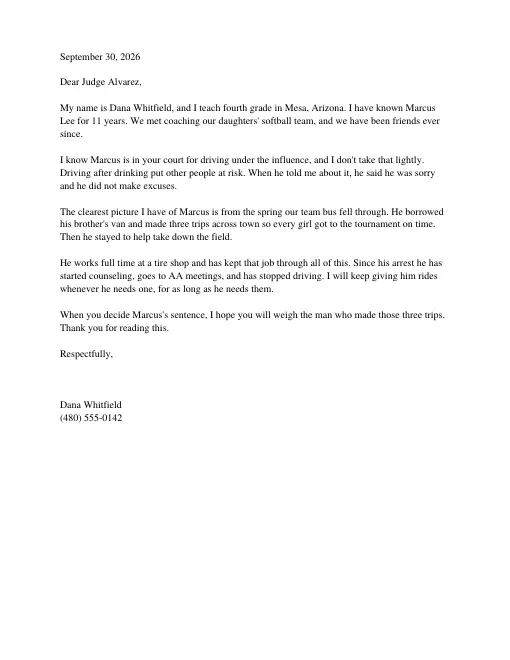
Here is the beginning of your letter.
What we did for you
Get your letter print-ready
Word + PDF · your details filled in · 3 tone rewrites · sending instructions
This letter + up to 4 more from family and friends · no two alike
See a sample print-ready letter (PDF) · Word
Family pack: you pay once → you get a private link → each relative or friend answers their own questions and gets their own letter → everyone downloads from their own page.
Questions people ask
What is the best way to write a character letter for court?
Start with a free federal defender guide so you know what judges look for, write down one or two true stories you saw yourself, then use a drafting tool or AI assistant only to organize your own words. Send the letter to the defense attorney, not the judge.
Are free character letter generators any good?
They can give you a structure quickly. Most are general letter generators, so check the result against court guidance: no invented details, no claim of innocence, no request for a sentence, no private information, one page.
Should I pay for a character letter?
You don’t have to. The guidance is free and a letter from you should be in your own words. A paid tool is worth it only if it saves you real time or catches mistakes you would otherwise miss — for example when several family members each need their own letter.
Can a lawyer write the character letter for me?
No — the letter has to come from you, in your words, or it loses its value. The defense attorney can tell you whether to write one, what to focus on, and where to send it, and should review it before it is filed.
How many character letters should be sent for one case?
Ask the attorney. A handful of specific, different letters usually helps more than a large stack; judges notice when letters share the same wording.
Last reviewed 2026-09-30. This page is general information, not legal advice. It follows published guidance from federal defender offices and federal courts, including:
- Writing a Character Letter — Federal Public Defender, District of Maryland
- Letter of Support — Federal Public Defender, District of Vermont
- Character Letters in Support of Sentencing — U.S. District Court, District of Arizona
How we use these sources and test our letters: about CharacterLetter.com.