
How to write a character reference letter for child custody
A custody reference is not a popularity letter. It gives the court clear, firsthand observations about a parent’s care, routines and relationship with the child—without attacking the other parent or deciding the case yourself.
Write yours nowFree character letter for court tool · about 5 minutes · no sign-up
Before you write
- Ask the attorney whether a letter is useful, who should write it, and when it is due.
- Use only facts you personally observed.
- Keep the child’s safety, stability and day-to-day needs at the center.
- Do not criticize the other parent or recommend a custody outcome.
- Give the signed letter to the attorney, not directly to the judge.
What the court needs from a reference writer
Custody rules vary by state, but courts generally decide according to the child’s best interests. A useful reference does not quote the law. It adds trustworthy facts the court can evaluate: what you have seen of the parent’s care, consistency, judgment and relationship with the child.
Your role matters. A teacher may know school attendance and communication. A neighbor may see daily routines. A coach may know whether the parent arrives, follows through and supports the child. State that vantage point clearly so the reader knows how you learned each fact.
Facts worth including
- Safe, consistent care: meals, bedtime, transportation, supervision, appointments or other routines you personally see.
- School and activities: attendance at meetings, homework support, practices, events or communication with teachers and coaches.
- Emotional support: how the parent listens, sets boundaries, comforts the child or responds when the child is upset.
- Reliability: whether the parent arrives when promised, prepares what the child needs and follows through over time.
- Relationship: a short, specific interaction that shows trust, warmth, patience or age-appropriate guidance.
Use observable language. “I saw Maya pick Leo up from practice every Tuesday from September through December” is stronger than “Maya is always responsible.”
A simple five-part structure
- Introduce yourself. Give your name, occupation if relevant, and how you know the parent and child.
- Explain your opportunity to observe. Say how often, where, and for how long you have seen them together.
- Describe one or two specific examples. Include the routine, action and result without guessing at motives.
- State the pattern you have personally seen. Reliability, attention, safety, patience or support.
- Close neutrally. Offer to answer questions and ask the court to consider your observations.
Sample child-centered paragraph
I have coached Elena’s daughter, Sofia, for the past two soccer seasons. Elena brings her to practice every Tuesday and Thursday with her uniform, water and medication already packed, and she stays nearby when Sofia’s asthma is acting up. In November, after Sofia became discouraged during a game, I watched Elena listen quietly, help her slow her breathing and ask what support she wanted before they left. In my experience, Elena is consistent, prepared and attentive to Sofia’s needs.
Fictional example. Use your own firsthand facts and ask the attorney before including a child’s full name or health information.
What to leave out
- Attacks on the other parent, their family, attorney or the court.
- Rumors, secondhand stories, diagnoses or claims about motives.
- Statements that one parent “deserves” custody or that the case is obvious.
- Legal conclusions or predictions about what the judge will decide.
- Private details the attorney did not request: addresses, birth dates, school schedules, case numbers or unnecessary medical information.
Before you sign
- Can you explain how you know every fact in the letter?
- Did you describe the child’s experience instead of the parents’ dispute?
- Did you remove accusations, rumors and unnecessary private details?
- Is the letter short enough to read in one sitting—usually one page?
- Has the attorney reviewed where, when and how it should be submitted?
Sources and limits. Last reviewed October 6, 2026. This page is general writing information, not legal advice. Custody factors and evidence rules vary by jurisdiction. The child-centered approach reflects the New York Courts’ public explanation of the best interests of the child. For broader examples of what reference writers discuss, see FindLaw’s custody reference overview. Ask the attorney handling the case before submitting any letter.
Draft your child custody character reference
We start from this page’s situation — just check a few boxes and add one true story.
Let's start with you.
There are no wrong answers, and you can change anything later.
Tell us about them.
Only what you know to be true — a judge can tell the difference.
About you — for the opening line and signature (optional, you can add it later)
The moment you'd want the judge to see.
One true memory does more than any list of good qualities. Small, everyday moments are often the most powerful.
Here is the beginning of your letter.
What we did for you
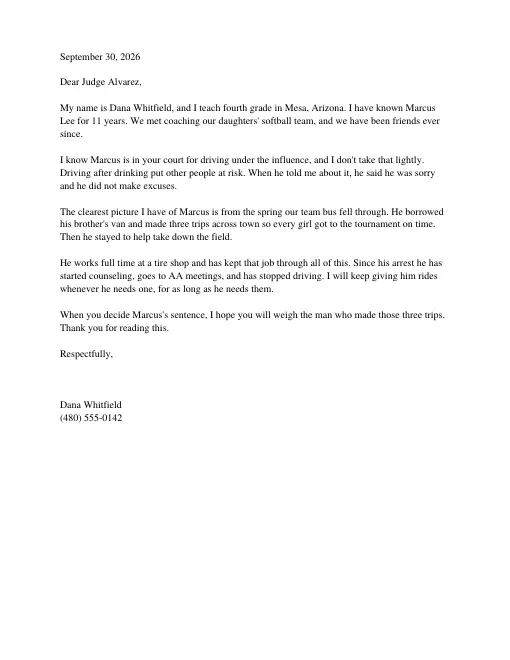
Get your letter print-ready
Word + PDF · your details filled in · 3 tone rewrites · sending instructions
This letter + up to 4 more from family and friends · no two alike
See a sample print-ready letter (PDF) · Word
Family pack: you pay once → you get a private link → each relative or friend answers their own questions and gets their own letter → everyone downloads from their own page.
Questions people ask
Who can write a character reference letter for child custody?
A teacher, coach, neighbor, family friend, childcare provider, employer, clergy member, or relative who has personally observed the parent with the child. The attorney should confirm whether a letter is useful and who should write it.
What should a child custody character reference include?
Explain who you are, how long you have known the parent and child, and two or three specific things you personally observed: safe routines, school involvement, medical care, emotional support, reliability, or the parent-child relationship. Keep the focus on the child.
Should I criticize the other parent?
No. Avoid attacks, diagnoses, rumors, and conclusions about who should win custody. Describe only conduct you personally witnessed, using dates or routines when you can, and let the court weigh it.
Can I include the child’s name or private details?
Use only the identifying information the attorney requests. Avoid addresses, dates of birth, school schedules, medical details, case numbers, and other private information that is not necessary.
Do I send the letter directly to the judge?
Usually no. Give the signed draft to the parent’s attorney. The attorney can decide whether and how it may be submitted under the court’s rules.
Last reviewed 2026-10-06. This page is general information, not legal advice.