
How to address a judge in a letter
Pick the court and type the judge’s last name — we’ll show exactly what goes at the top of the letter and how to open it. Examples for every kind of judge are below.
Write yours nowFree character letter for court tool · about 5 minutes · no sign-up
The three parts of addressing a judge
A letter to a judge has three places where the judge’s title matters, and each one uses a different form:
- The address block (top left, under the date): the formal title, “The Honorable”, followed by the judge’s full name, the court and its address.
- The greeting: “Dear Judge Last name,”. If you don’t know the name, “Dear Your Honor,”.
- In the body: refer to the judge as “the Court” or “Your Honor” — for example, “I respectfully ask the Court to consider…”.
Examples for each court
State trial court judge
The Honorable Sarah Thompson
[County] Superior Court
[Court street address]
[City, State ZIP]
Dear Judge Thompson,
Federal district judge
The Honorable Michael Grant
United States District Judge
United States District Court for the [District]
Dear Judge Grant,
Federal magistrate judge
The Honorable Lisa Chen
United States Magistrate Judge
Dear Judge Chen,
Appellate judge or state supreme court justice
The Honorable Robert Hale
Justice, [State] Supreme Court
Dear Justice Hale,
Names above are fictional examples.
Common mistakes
- “To whom it may concern” or “Dear Sir/Madam”. It reads as a form letter. Use the judge’s name or “Your Honor”.
- Using the judge’s first name in the greeting.
- Mr., Mrs. or Ms. instead of Judge.
- “Honorable” in the greeting — “Dear Honorable Thompson” is wrong; the greeting is “Dear Judge Thompson,”.
- Sending it straight to the judge. Most letters about a pending case should go through the defense attorney, who knows how that judge wants them submitted.
Where to find the judge’s name
The defense attorney will know. The judge’s name also appears on court notices and on the online case docket for most courts. If you can’t find it, “Dear Your Honor,” is perfectly correct — it is better than guessing.
Now write the letter itself
We start from this page’s situation — just check a few boxes and add one true story.
Let's start with you.
There are no wrong answers, and you can change anything later.
Family relationship (optional)
Tell us about them.
Only what you know to be true — a judge can tell the difference.
About you — for the opening line and signature (optional, you can add it later)
The moment you'd want the judge to see.
One true memory does more than any list of good qualities. Small, everyday moments are often the most powerful.
Here is the beginning of your letter.
What we did for you
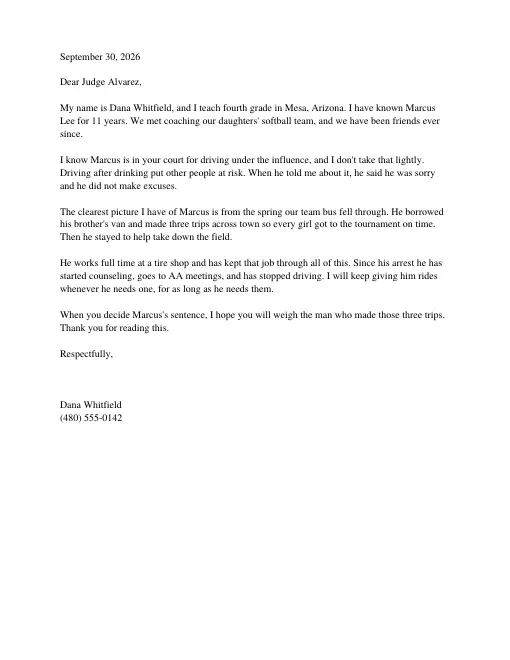
Get your letter print-ready
Word + PDF · your details filled in · 3 tone rewrites · sending instructions
This letter + up to 4 more from family and friends · no two alike
See a sample print-ready letter (PDF) · Word
Family pack: you pay once → you get a private link → each relative or friend answers their own questions and gets their own letter → everyone downloads from their own page.
Questions people ask
Do I write “Dear Judge” or “Dear Your Honor”?
If you know the judge’s last name, write “Dear Judge Thompson,”. If you don’t, “Dear Your Honor,” is correct and respectful.
How do I address a female judge?
Exactly the same way: “Dear Judge <Last name>,”. Don’t use Mrs., Ms., Miss or Sir/Madam.
What does “The Honorable” mean on the envelope or address block?
It is the formal title for judges used in the address block and on envelopes — “The Honorable Sarah Thompson”. In the greeting you switch to “Dear Judge Thompson,”.
How do I address a magistrate judge?
Address block: “The Honorable <Full name>, United States Magistrate Judge”. Greeting: “Dear Judge <Last name>,”.
How do I end a letter to a judge?
Use “Respectfully,” or “Respectfully submitted,” followed by your handwritten signature, your printed name and your contact details.
Last reviewed 2026-09-28. This page is general information, not legal advice. It follows published guidance from federal defender offices and federal courts, including:
- Writing a Character Letter — Federal Public Defender, District of Maryland
- Letter of Support — Federal Public Defender, District of Vermont
- Character Letters in Support of Sentencing — U.S. District Court, District of Arizona
How we use these sources and test our letters: about CharacterLetter.com.