
Character letter for immigration: good moral character
Support letters are often part of naturalization applications, waivers and immigration court cases. The strongest ones speak to exactly what officers and judges weigh: family ties, work, community, and honesty.
Write yours nowFree character letter for court tool · about 5 minutes · no sign-up
What officers look for
In naturalization cases, USCIS decides “good moral character” by looking at the whole picture. Its policy manual lists favorable factors such as family ties and background, employment history, education, meeting financial obligations and paying taxes, community involvement, and the applicant’s time in the United States. A good support letter speaks to one or more of these from first-hand experience.
What to include
- Who you are. Your name, city, occupation, and — if the attorney asks — your immigration or citizenship status.
- How you know the applicant and for how long.
- Specific examples of their work, family life, reliability, volunteer service or faith community involvement.
- If there is a past problem the attorney has told you about, a brief acknowledgment and what you have seen since. Don’t describe it in detail.
- Your signature and contact details, and a willingness to be contacted.
What never to write
- Anything about how or when the person entered the country, their documents, or their current status — leave that to the attorney.
- Promises of financial support you haven’t actually agreed to (financial sponsorship uses separate forms).
- Guesses, exaggerations, or anything you don’t personally know to be true.
Sample paragraph
Carlos has worked on my landscaping crew for seven years. In that time he has never missed a payroll-reporting deadline, he files his taxes every year, and last spring I promoted him to crew leader because the other workers already went to him with questions. When a customer’s elderly husband fell in their yard, Carlos stayed with him until the ambulance arrived and then finished the job without charging for the extra hour.
Fictional example.
Write yours in about 3 minutes
We start from this page’s situation — just check a few boxes and add one true story.
Let's start with you.
There are no wrong answers, and you can change anything later.
Tell us about them.
Only what you know to be true — a judge can tell the difference.
About you — for the opening line and signature (optional, you can add it later)
The moment you'd want the judge to see.
One true memory does more than any list of good qualities. Small, everyday moments are often the most powerful.
Here is the beginning of your letter.
What we did for you
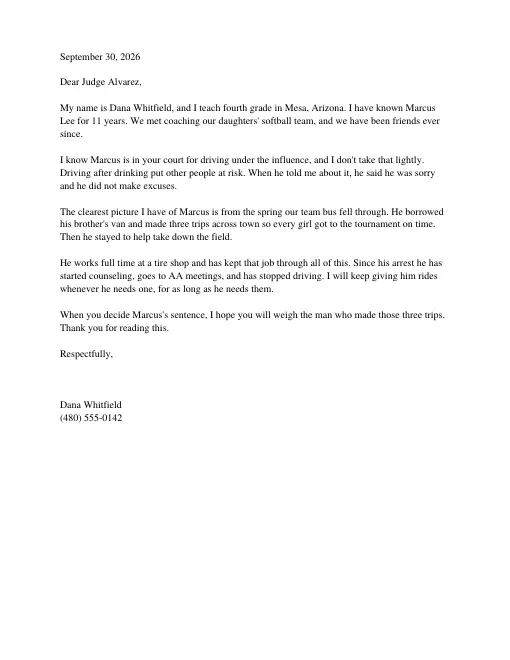
Get your letter print-ready
Word + PDF · your details filled in · 3 tone rewrites · sending instructions
This letter + up to 4 more from family and friends · no two alike
See a sample print-ready letter (PDF) · Word
Family pack: you pay once → you get a private link → each relative or friend answers their own questions and gets their own letter → everyone downloads from their own page.
Questions people ask
Who should write a good moral character letter for immigration?
People who know the applicant well and can speak from experience: employers, coworkers, neighbors, clergy, teachers, community leaders, and family members. U.S. citizens and permanent residents are often asked to include their status and contact details — the immigration attorney will say what is needed.
What does USCIS consider for good moral character?
Officers look at the totality of the circumstances. Positive factors in USCIS policy include family ties, employment history, education, paying taxes and meeting financial obligations, community involvement, compliance with probation, and length of time in the United States.
Should the letter be notarized?
It depends on the case. Some attorneys ask for a signed and notarized letter or a declaration. Ask before you finalize it.
Who do I address the letter to?
For a USCIS application, “Dear Immigration Officer,” is common. For immigration court, address the immigration judge: “Dear Judge <Last name>,” or “Dear Your Honor,”.
Last reviewed 2026-09-28. This page is general information, not legal advice. It follows published guidance from federal defender offices and federal courts, including:
- Writing a Character Letter — Federal Public Defender, District of Maryland
- Letter of Support — Federal Public Defender, District of Vermont
- Character Letters in Support of Sentencing — U.S. District Court, District of Arizona
How we use these sources and test our letters: about CharacterLetter.com.