
How to write a parole support letter
Parole boards read support letters looking for one thing above all: a real plan. Where will the person live, how will they get to work, who will help them stay on track? Put that where the board can’t miss it.
Write yours nowFree character letter for court tool · about 5 minutes · no sign-up
Put the release plan near the top
Guidance written for parole applicants’ families is consistent on this point: the concrete support you are offering is the most important part of the letter, so don’t bury it at the end. Be specific:
- Housing — where they will live, who else lives there, how long they can stay.
- Work — a job offer with the employer’s name and role, or specific help finding work.
- Transportation — who will drive them to work, parole appointments and treatment.
- Recovery and support — meetings near the home, a counselor, a mentor, a faith community.
Then describe the change you have seen
How have you stayed in contact, and what is different now? Programs completed, education, how they talk about the harm they caused. Stick to what you have seen or heard yourself.
What parole boards distrust
- Calling the crime a “mistake” or downplaying the harm.
- Calling the person a “model inmate” without facts to back it up.
- Telling the board what it should decide.
- General praise with no plan attached.
Sample release-plan paragraph
When Darnell is released, he will live with me in my two-bedroom house in Stockton, where he will have his own room. My cousin, who owns a welding shop ten minutes away, has offered him a full-time job, and I will drive him to work and to every parole appointment until he can get there on his own. There is a Tuesday-night AA meeting at our church, and I will go with him.
Fictional example.
Write yours in about 3 minutes
We start from this page’s situation — just check a few boxes and add one true story.
Let's start with you.
There are no wrong answers, and you can change anything later.
Family relationship (optional)
Tell us about them.
Only what you know to be true — a judge can tell the difference.
About you — for the opening line and signature (optional, you can add it later)
The moment you'd want the judge to see.
One true memory does more than any list of good qualities. Small, everyday moments are often the most powerful.
Here is the beginning of your letter.
What we did for you
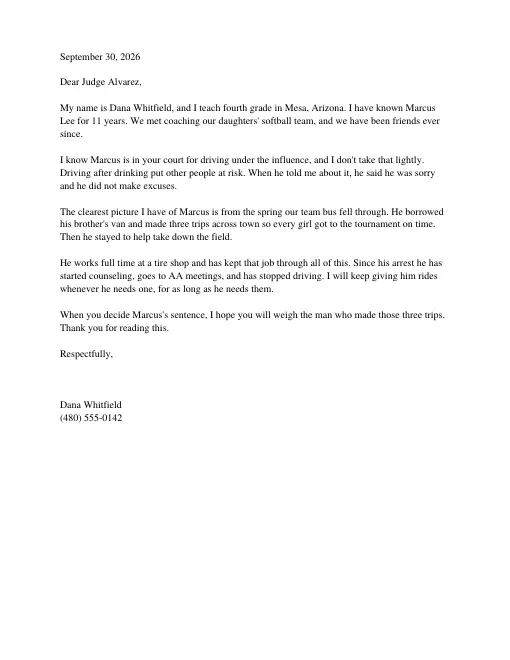
Get your letter print-ready
Word + PDF · your details filled in · 3 tone rewrites · sending instructions
This letter + up to 4 more from family and friends · no two alike
See a sample print-ready letter (PDF) · Word
Family pack: you pay once → you get a private link → each relative or friend answers their own questions and gets their own letter → everyone downloads from their own page.
Questions people ask
What should a parole support letter include?
Who you are and how you know the person, how you have stayed in contact, positive changes you have seen, and — most important — the specific help you will give after release: housing, a job, transportation, or support with treatment.
Who do I address a parole support letter to?
“Dear Members of the Parole Board,” is the standard greeting. Check the board’s instructions for the exact mailing address and any ID number to include.
When should I send a parole support letter?
Well before the hearing. Many attorneys recommend letters dated within the last 6–12 months, and updating older letters so the board knows your support is current.
Can I send a letter if I haven’t visited?
Yes. Say how you have stayed in touch — letters, calls, video visits — and be honest about it.
Last reviewed 2026-09-28. This page is general information, not legal advice. It follows published guidance from federal defender offices and federal courts, including:
- Writing a Character Letter — Federal Public Defender, District of Maryland
- Letter of Support — Federal Public Defender, District of Vermont
- Character Letters in Support of Sentencing — U.S. District Court, District of Arizona
How we use these sources and test our letters: about CharacterLetter.com.