
Character letter for court examples
These five character letter for court examples cover family members, friends, employers, DUI cases and federal sentencing. Choose a sample for your situation, follow its structure, and replace every detail with facts you personally know.
Write yours nowFree character letter for court tool · about 5 minutes · no sign-up
A sister writes to the judge before her brother’s sentencing.
Character letter for a friendA long-time friend writes before sentencing in a theft case.
Employer character letter for courtA manager writes for an employee facing a drug charge.
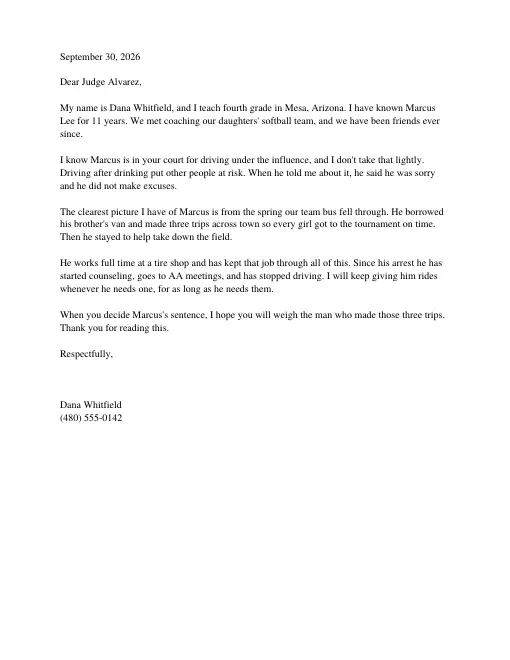
Character letter for a DUIDUI letters have their own rules: acknowledge that other people were put at risk, and focus on what has changed since — treatment, sobriety, and how the person gets around now..
Character letter for federal sentencingIn federal cases, the law tells the judge to consider the defendant’s “history and characteristics.” Character letters are how the court hears about them from people who know the defendant..
What these character letter for court examples have in common
- Who you are — your name, city, job, how you know the person and for how long.
- You understand why they’re in court — one or two sentences, without arguing the facts.
- One true, specific story — something you saw with your own eyes.
- What they have done since — work, treatment, restitution, support.
- A respectful ask — that the court consider it. No specific sentence.
How to adapt a sample without copying it
Use these character letter for court examples for structure, not as a script. Replace broad praise such as “an upstanding member of the community” with one specific moment you saw yourself. Keep only details you know are true. Our tool asks you a few questions about that experience to help you draft in your own words.
If you want to write it yourself, follow how to write a character letter for court step by step, use the focused child custody character reference guide, or start from our character letter template — an outline with prompts rather than stock sentences. You can also listen to the Character Letter Podcast before you draft.
Write yours in about 3 minutes
We start from this page’s situation — just check a few boxes and add one true story.
Let's start with you.
There are no wrong answers, and you can change anything later.
Family relationship (optional)
Tell us about them.
Only what you know to be true — a judge can tell the difference.
About you — for the opening line and signature (optional, you can add it later)
The moment you'd want the judge to see.
One true memory does more than any list of good qualities. Small, everyday moments are often the most powerful.
Here is the beginning of your letter.
What we did for you
Get your letter print-ready
Word + PDF · your details filled in · 3 tone rewrites · sending instructions
This letter + up to 4 more from family and friends · no two alike
See a sample print-ready letter (PDF) · Word
Family pack: you pay once → you get a private link → each relative or friend answers their own questions and gets their own letter → everyone downloads from their own page.
Questions people ask
Can I copy a sample character letter for court?
You shouldn’t. Judges read many letters and recognize templates; copied letters can hurt credibility. Use the samples to see the structure, then write about what you have personally seen.
How long should a character reference letter for court be?
One page — usually 250 to 400 words, in four or five short paragraphs.
What is the format of a character letter for court?
Date, “Dear Judge <Last name>,” (or “Dear Your Honor,”), four or five paragraphs, “Respectfully,”, your signature, printed name and contact details.
Last reviewed 2026-09-28. This page is general information, not legal advice. It follows published guidance from federal defender offices and federal courts, including:
- Writing a Character Letter — Federal Public Defender, District of Maryland
- Letter of Support — Federal Public Defender, District of Vermont
- Character Letters in Support of Sentencing — U.S. District Court, District of Arizona
How we use these sources and test our letters: about CharacterLetter.com.