
Character reference letter for court template
Use this free character reference letter for court template as a starting outline. Copy it or download the Word file, replace every bracket with facts you personally know, and write the final letter in your own words.
Write yours nowFree character letter for court tool · about 5 minutes · no sign-up
Before you copy it: judges read many letters for the same hearing and recognize template wording. Use this for the structure — then write each part in your own words, with details only you know. That is what makes a letter count.
Copy the character reference letter for court template
[Date]

Dear Judge [Last name],

My name is [your full name], and I live in [city, state], where I work as [your job]. I have known [person's full name] for [number] years as their [relationship: brother, coworker, neighbor, pastor...].

I understand that [first name] is before the Court for [a short, plain description, e.g. "a DUI" or "a serious offense"], and I am not writing to excuse it. [Optional, only if true: one sentence about what they have said or shown to you about it.]

[One specific story you saw yourself: when and where it happened, what they did, and what it meant for the people involved. Two to four sentences.]

Since [the arrest / the charge], [first name] has [only what you know is true: kept working at..., started counseling, attended meetings, paid back..., cared for...].

[How you will support them going forward: rides, a place to stay, help with work, weekly check-ins. Only what you will really do.]

I respectfully ask the Court to consider these things about [first name]. Thank you for your time.

Respectfully,


[Handwritten signature]
[Printed full name]
[Phone number or email]
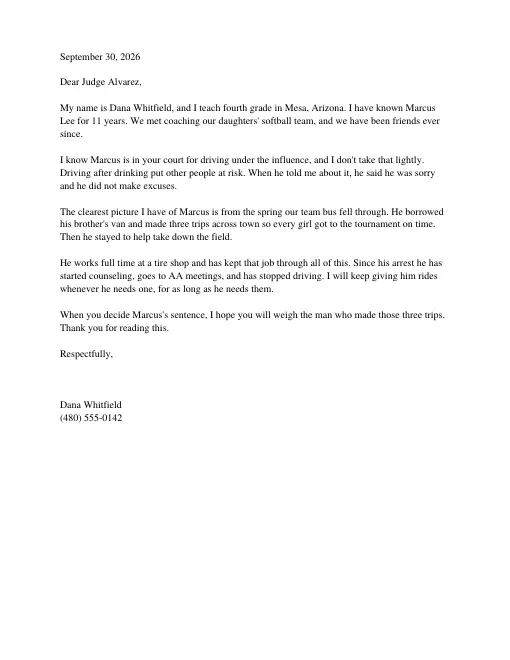
How to personalize your character reference letter
- Date and greeting. Use the date you sign it. Address a trial judge as “Dear Judge [Last name],”; if you don’t know the name, “Dear Your Honor,”. Other courts and boards are different — see how to address a judge in a letter.
- Who you are. Name, city, job, relationship and how many years. This is what makes the rest believable.
- The case. One or two sentences that show you know it is serious. Don’t describe or argue about the facts.
- Your story. The paragraph a template can’t write. One moment you saw yourself — when, where, what they did. See examples in how to write a character letter for court.
- Since the charge. Treatment, work, meetings, restitution, family — only what you know.
- Support. What you will actually do to help them going forward.
- Close. A respectful request to consider what you shared. No specific sentence.
Opening lines by relationship
Pick the one closest to you and change it until it sounds like you.
| If you are… | You might start with |
|---|---|
| Family member | “My name is [name]. I am [first name]’s older sister, and I have known him every day of his [number] years.” |
| Friend | “My name is [name], and I have been friends with [first name] since we worked together at [place] in [year].” |
| Employer or manager | “My name is [name], and I am the [title] at [company]. [First name] has worked for me as a [job] for [number] years.” |
| Pastor, coach or mentor | “My name is [name]. I am the [pastor / coach / volunteer coordinator] at [organization], where I have known [first name] for [number] years.” |
| Neighbor | “My name is [name], and I have lived next door to [first name] on the same street in [city] for [number] years.” |
Why most template letters don’t work
- They sound the same. When three letters in one file say “pillar of the community”, the judge stops reading closely.
- They are made of adjectives. “Kind, loyal and hard-working” tells the judge nothing a story wouldn’t show better.
- They include lines that hurt. Many free templates suggest asking for leniency or a specific outcome, or describing the offense as out of character in ways that read as minimizing.
- They run long. One page is the norm.
After you fill it in
- Read it out loud and cut anything you aren’t sure is true.
- Remove addresses, dates of birth, case numbers and children’s names.
- Print it, sign it by hand in blue or black ink, and give it to the defense attorney before their deadline.
Want to see finished letters that follow this outline? Read our sample character reference letters for court, including a family member letter, an employer letter and a DUI letter.
Or skip the template: answer a few questions instead
We start from this page’s situation — just check a few boxes and add one true story.
Let's start with you.
There are no wrong answers, and you can change anything later.
Family relationship (optional)
Tell us about them.
Only what you know to be true — a judge can tell the difference.
About you — for the opening line and signature (optional, you can add it later)
The moment you'd want the judge to see.
One true memory does more than any list of good qualities. Small, everyday moments are often the most powerful.
Here is the beginning of your letter.
What we did for you
Get your letter print-ready
Word + PDF · your details filled in · 3 tone rewrites · sending instructions
This letter + up to 4 more from family and friends · no two alike
See a sample print-ready letter (PDF) · Word
Family pack: you pay once → you get a private link → each relative or friend answers their own questions and gets their own letter → everyone downloads from their own page.
Questions people ask
Is it OK to use a template for a character letter?
Use a template for the structure, not the words. Judges and probation officers read many letters for the same hearing and notice when they share wording. Keep the order below, and replace every bracket with your own true details in your own words.
What is the format of a character letter for court?
Date, greeting (“Dear Judge [Last name],”), four to six short paragraphs, “Respectfully,”, your handwritten signature, printed name and contact details — all on one page.
Can I use this template for a character reference letter for a job or an apartment?
The structure works, but the content is written for court. For a job or landlord reference you would drop the paragraph about the case and focus on reliability and skills.
Is there a Word or Google Docs version?
Copy the template with the button on this page and paste it into Word, Google Docs or Pages — the brackets keep their place. If you use our tool, the finished letter can be copied for free or downloaded as a print-ready Word and PDF file.
What if several family members are writing?
Don’t share one filled-in template between you. Each person should tell a different story in their own words, or the letters will read alike. Our Family Pack gives each writer their own questions and makes sure no two letters match.
Last reviewed 2026-09-30. This page is general information, not legal advice. It follows published guidance from federal defender offices and federal courts, including:
- Writing a Character Letter — Federal Public Defender, District of Maryland
- Letter of Support — Federal Public Defender, District of Vermont
- Character Letters in Support of Sentencing — U.S. District Court, District of Arizona
How we use these sources and test our letters: about CharacterLetter.com.