
Character witness letter: how to write one
A character witness letter tells the court who the person is outside the case, from someone who knows them well. Here is what makes one credible — and what makes a judge ignore it.
Write yours nowFree character letter for court tool · about 5 minutes · no sign-up
What a character witness letter does
A court file mostly contains the worst day of someone’s life. A character witness letter adds the rest: how they treat their family, whether they show up for work, what they do for other people. At sentencing, judges are expected to weigh the person’s history and characteristics, and letters from credible people are one of the main ways that information reaches them.
What makes a character witness credible
- How well you know them. Years, and how often you see them. “We’ve worked side by side three days a week for six years” beats “I’ve known him a long time.”
- What you actually saw. First-hand examples, not things you heard from others.
- Your own standing. Your job or role — a teacher, a nurse, a pastor, a small-business owner — tells the judge who is vouching.
- Honesty about the case. Acknowledging that the matter is serious makes everything else you say more believable.
What to include
- Your name, city, occupation, and how and for how long you have known the person.
- A sentence showing you know why they are in court and take it seriously.
- One or two specific, true moments that show their character.
- What they have done since the arrest — only what you know to be true.
- A respectful request that the court consider your letter, your signature and contact details.
What to leave out
- Any claim that they are innocent, or discussion of the evidence.
- Blame for anyone else.
- A specific sentence you want the judge to give.
- Exaggeration — “the most honest person in the world” sounds like a friend being loyal, not a witness being accurate.
- Private details about others, especially children.
Examples
See complete character witness letters from a family member, a friend, an employer, and letters for a DUI and federal sentencing.
Write yours in about 3 minutes
We start from this page’s situation — just check a few boxes and add one true story.
Let's start with you.
There are no wrong answers, and you can change anything later.
Tell us about them.
Only what you know to be true — a judge can tell the difference.
About you — for the opening line and signature (optional, you can add it later)
The moment you'd want the judge to see.
One true memory does more than any list of good qualities. Small, everyday moments are often the most powerful.
Here is the beginning of your letter.
What we did for you
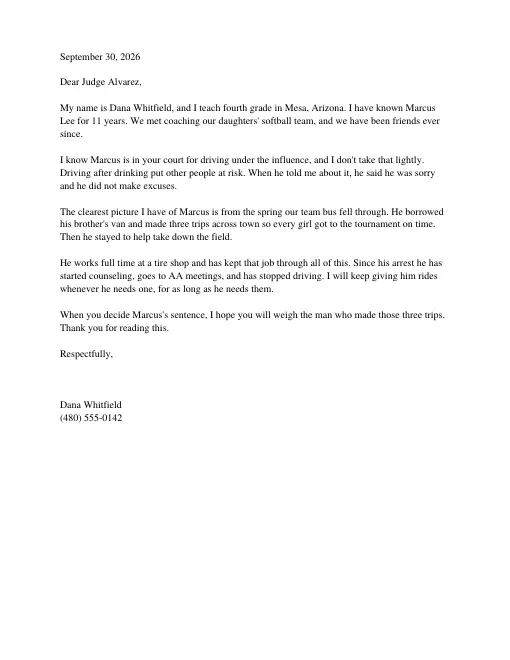
Get your letter print-ready
Word + PDF · your details filled in · 3 tone rewrites · sending instructions
This letter + up to 4 more from family and friends · no two alike
See a sample print-ready letter (PDF) · Word
Family pack: you pay once → you get a private link → each relative or friend answers their own questions and gets their own letter → everyone downloads from their own page.
Questions people ask
Is a character witness letter the same as testifying?
No. A letter is a written statement the attorney can give to the court. Testifying means appearing in court and being questioned. The attorney decides which, if either, is useful.
Who makes a good character witness?
Someone who has known the person well for a long time and can describe specific things they have seen: family, close friends, employers, coworkers, teachers, coaches, clergy, and people from support groups or volunteer work.
Can a character witness letter be used at trial?
Rarely. Character letters are mostly used at sentencing, in plea discussions, and in some family and immigration matters.
Do I need to have the letter notarized?
Usually not for a sentencing letter. Some courts or case types ask for a sworn declaration instead — the attorney will tell you if that applies.
Last reviewed 2026-09-28. This page is general information, not legal advice. It follows published guidance from federal defender offices and federal courts, including:
- Writing a Character Letter — Federal Public Defender, District of Maryland
- Letter of Support — Federal Public Defender, District of Vermont
- Character Letters in Support of Sentencing — U.S. District Court, District of Arizona
How we use these sources and test our letters: about CharacterLetter.com.