
How to write a letter to a judge
If someone you care about is facing sentencing, this guide shows how to write a letter to a judge that is clear, respectful and grounded in facts you have personally seen.
Write yours nowFree character letter for court tool · about 5 minutes · no sign-up
Before sentencing: check with the attorney
If you are writing a letter to a judge before sentencing, the defense attorney decides whether letters will help and how they are submitted. Some judges want letters sent to the probation office; others want them attached to a sentencing memorandum; a few limit how many they will accept. Ask the attorney three questions: should I write one, who do I send it to, and by when?
How to write a letter to a judge: 5 steps
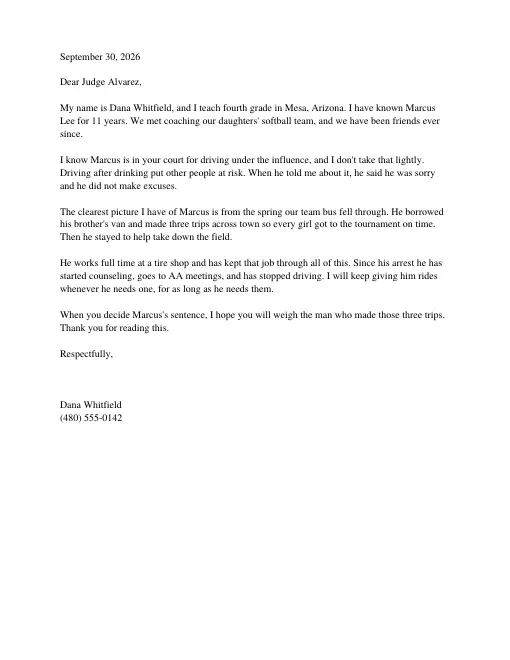
- Introduce yourself. Your name, where you live, what you do, how you know the person and for how long. This is what makes the letter credible.
- Show you understand why they’re in court. One or two sentences. Don’t describe the offense and don’t argue about it.
- Tell one true, specific story. Something you saw them do — for family, at work, in the community. One real moment is worth more than a paragraph of adjectives.
- Say what has changed. Treatment, meetings, steady work, restitution, the support around them — whatever you know to be true.
- Make a respectful request. Ask the court to consider what you have shared. Don’t ask for a specific sentence unless the attorney tells you to.
Letter to a judge template (structure)
[Date]
The Honorable [Judge’s full name]
[Court name and address]
Dear Judge [Last name],
My name is [your name], and I live in [city, state], where I work as [your job]. I have known [person’s name] for [number] years as their [relationship].
I understand that [first name] is before the Court for a serious matter, and I am not writing to excuse it. [One sentence about what they have said or shown to you about it.]
[One specific, true moment that shows who they are.]
Since [the arrest / the charge], [first name] has [what they have actually done].
I respectfully ask the Court to consider these things. Thank you for your time.
Respectfully,
[Signature]
[Printed name]
[Phone or email]
Don’t fill this in word for word — judges recognize template letters. Use it to see the order, or let our tool ask you the questions and write it in your own voice.
How to end a letter to a judge
Close with “Respectfully,” then leave space for your handwritten signature, and print your full name and a phone number or email under it. Offering to be contacted shows you stand behind what you wrote.
Mistakes that make judges discount a letter
- Saying the person is innocent, was set up, or that the charges are unfair.
- Blaming the victim, the police, a co-defendant or an ex-partner.
- Telling the judge what sentence to give (“please don’t send him to jail”).
- Calling the offense “just a mistake” or saying “nobody got hurt”.
- Going past one page, or writing the person’s life story.
- Using a template that dozens of other letters have used.
For the exact greeting and address block for each type of court, see how to address a judge in a letter. For complete samples, see our example character letters; for a paragraph-by-paragraph walkthrough, see how to write a character letter for court, and for a fill-in outline, our character letter for court template.
Write yours in about 3 minutes
We start from this page’s situation — just check a few boxes and add one true story.
Let's start with you.
There are no wrong answers, and you can change anything later.
Tell us about them.
Only what you know to be true — a judge can tell the difference.
About you — for the opening line and signature (optional, you can add it later)
The moment you'd want the judge to see.
One true memory does more than any list of good qualities. Small, everyday moments are often the most powerful.
Here is the beginning of your letter.
What we did for you
Get your letter print-ready
Word + PDF · your details filled in · 3 tone rewrites · sending instructions
This letter + up to 4 more from family and friends · no two alike
See a sample print-ready letter (PDF) · Word
Family pack: you pay once → you get a private link → each relative or friend answers their own questions and gets their own letter → everyone downloads from their own page.
Questions people ask
Can I write a letter to a judge?
Yes, but in a pending criminal case the letter should almost always go through the defense attorney, not straight to the judge. Many judges will not read letters sent to them directly, and some courts forbid it.
Does writing a letter to the judge help?
A good letter can. At sentencing, judges consider the person’s history and character, and letters from people who know them are one of the few ways the court hears about that. A letter that argues the case or attacks others can hurt.
Can the defendant write a letter to the judge?
Sometimes — but only with the attorney’s approval, because anything the defendant writes can be used in the case. This page is about letters from family, friends and others who support them.
What should a letter to a judge before sentencing say?
Who you are, how you know the person, that you understand the case is serious, one specific true example of their character, what they have done since, and a respectful request that the court consider it.
How do I start a letter to a judge?
“Dear Judge <Last name>,” — or “Dear Your Honor,” if you don’t know the name. Then introduce yourself in the first sentence.
Last reviewed 2026-10-06. This page is general information, not legal advice. It follows published guidance from federal defender offices and federal courts, including:
- Writing a Character Letter — Federal Public Defender, District of Maryland
- Letter of Support — Federal Public Defender, District of Vermont
- Character Letters in Support of Sentencing — U.S. District Court, District of Arizona
How we use these sources and test our letters: about CharacterLetter.com.