
How to write a character letter for court
A character letter — also called a character reference letter or a letter of support — tells the judge who someone is outside the case file, from a person who knows them. You don’t need to be a good writer. You need to be specific, honest and brief. Here is how to do it, paragraph by paragraph.
Write yours nowFree character letter for court tool · about 5 minutes · no sign-up
The short version
- Length: one page, about 250–400 words.
- Greeting: “Dear Judge [Last name],” or “Dear Your Honor,”.
- Order: who you are → you know the case is serious → one true story → what they have done since → how you will support them → respectful close.
- Never: claim innocence, blame anyone, ask for a specific sentence, minimize, or include addresses, dates of birth or children’s names.
- Send it to: the defense attorney, signed and dated, before their deadline.
Before you write: three questions for the attorney
Five minutes with the defense attorney saves you from writing the wrong letter. Ask:
- Should I write one, and what should I focus on? The attorney knows what the judge will weigh — work history, family responsibilities, sobriety, community service.
- Who is it addressed to? The judge’s name, or a parole board, or an immigration officer.
- When and how do I get it to you? Most letters go through the attorney, not directly to the court.
Then write down, in your own words, what you actually know: how long you have known the person, one or two moments you saw yourself, and what they have done since the charge. Those notes are the whole letter; the rest is order and tone.
Step 1: Introduce yourself
The judge first needs to know why your opinion is worth reading. Give your full name, the city you live in, what you do for a living, and how you know the person and for how long.
“My name is [your name]. I am a respiratory therapist in [city, state], and I have been [first name]’s neighbor for nine years.”
Mistake to avoid: opening with how wonderful the person is. Earn that with the story first.
Step 2: Show you understand why they are in court
One or two sentences. Judges discount letters that seem unaware of the charge or that argue with it. You don’t need to describe the offense.
“I know [first name] is before the Court for a serious offense, and I am not writing to excuse it.”
If the person has talked to you about what they did, and you believe them, you can say so plainly: “He has told me more than once that he is ashamed of the choice he made.” Only write this if it really happened.
Step 3: Tell one true, specific story
This is the heart of the letter. Pick one thing you saw the person do that shows who they are on an ordinary day — how they treated a parent, a coworker, a child, a neighbor. Say where and when, what they did, and what happened because of it.
“When my husband was in the hospital for six weeks in 2023, [first name] mowed our lawn every Saturday without being asked, and brought our mail in so I didn’t have to leave his room.”
One real moment is worth more than a paragraph of adjectives like “kind”, “hard-working” or “loyal”. If you can’t think of a story, think about the last time the person helped someone — that is usually it.
Mistake to avoid: filling in details you aren’t sure of. If you weren’t there, don’t describe it as if you were.
Step 4: Say what they have done since
Judges want to know whether things have changed. Include only what you know to be true: steady work, treatment or counseling, meetings, paying restitution, staying sober, caring for a family member.
“Since his arrest, [first name] has kept the same job at [employer], and I have driven him to his Tuesday evening meetings for the past five months.”
Step 5: Say how you will support them
A support system is one of the things sentencing judges and parole boards look for. Be concrete: rides, a place to live, help finding work, checking in every week. Don’t promise more than you will do.
“If the Court allows, he will live with my wife and me, and I will help him get to work and to every appointment.”
Step 6: Close respectfully
Ask the court to consider what you have shared — without telling it what sentence to give. Thank the judge, sign, and give a way to reach you.
“I respectfully ask the Court to consider these things about [first name]. Thank you for your time.”
Then “Respectfully,”, a space for your handwritten signature, your printed name and a phone number or email. For the right greeting and address block for each kind of court, see how to address a judge in a letter.
Format: how a character letter for court should look
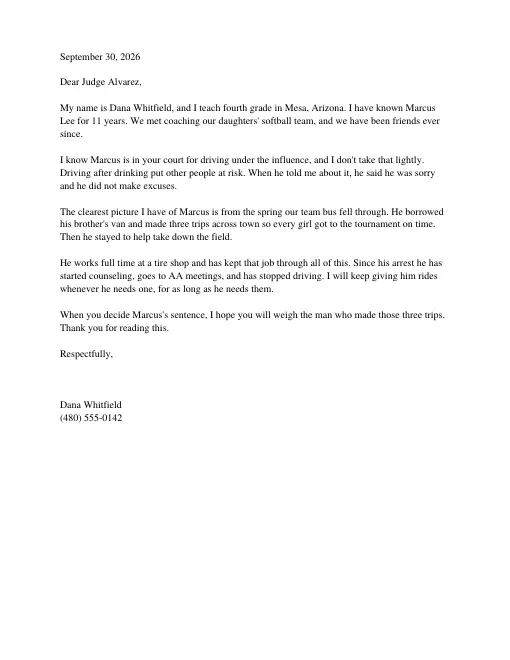
- One page, typed, in a plain font (Times New Roman or Arial, 11–12 pt), with normal margins.
- Date at the top, then the greeting. The judge’s address block is optional unless the attorney asks for it.
- Four to six short paragraphs, in plain everyday English. Write the way you talk to someone you respect.
- Signed by hand in blue or black ink, with your printed name and contact details below.
- Employers can use company letterhead and sign with their title.
What to leave out
- Saying the person is innocent, was set up, or that the charges are unfair.
- Blaming the victim, the police, a co-defendant or an ex-partner.
- Asking for a particular sentence (“please give him probation”) unless the attorney asks you to.
- Minimizing (“it was only a mistake”, “nobody got hurt”, “just two beers”).
- Exaggeration (“the most honest person in the world”). It makes the rest of the letter harder to believe.
- Private details: addresses, dates of birth, Social Security or case numbers, children’s names. Letters often become part of the court record.
Before you sign: a 60-second checklist
- Is every sentence something you saw yourself or know to be true?
- Does it fit on one page?
- Is the judge addressed correctly?
- Does it acknowledge the case without arguing about it?
- Is there at least one specific story, not just adjectives?
- Did you remove private details?
- Read it out loud. Does it sound like you?
Want to see finished letters?
Read our sample character reference letters for court — from a family member, a friend, an employer, and for a DUI and a federal sentencing — or use the focused guide for a child custody character reference letter. You can also start from our character letter for court template, listen to the short audio guides, or use a ChatGPT prompt and checklist that keep it honest. Or answer a few questions below and we’ll draft it with you, in your own words.
Write your character letter now
We start from this page’s situation — just check a few boxes and add one true story.
Let's start with you.
There are no wrong answers, and you can change anything later.
Family relationship (optional)
Tell us about them.
Only what you know to be true — a judge can tell the difference.
About you — for the opening line and signature (optional, you can add it later)
The moment you'd want the judge to see.
One true memory does more than any list of good qualities. Small, everyday moments are often the most powerful.
Here is the beginning of your letter.
What we did for you
Get your letter print-ready
Word + PDF · your details filled in · 3 tone rewrites · sending instructions
This letter + up to 4 more from family and friends · no two alike
See a sample print-ready letter (PDF) · Word
Family pack: you pay once → you get a private link → each relative or friend answers their own questions and gets their own letter → everyone downloads from their own page.
Questions people ask
How do you write a good character letter for court?
Introduce yourself and how long you have known the person, acknowledge that the case is serious, tell one specific true story you saw yourself, describe what they have done since the charge and how you will support them, and close with a respectful request that the court consider what you shared. Keep it to one page and give it to the defense attorney.
How long should a character letter for court be?
One page: roughly 250 to 400 words in four to six short paragraphs. Judges and probation officers read many letters for one hearing, and a short specific letter is read more closely than a long one.
Should a character letter mention the crime?
Briefly. One or two sentences that show you know why they are in court and take it seriously. Don’t describe the offense in detail, argue about the facts or say they are innocent. Ask the attorney if you are unsure how much to say.
Who do I address a character letter to?
Usually “Dear Judge [Last name],” — or “Dear Your Honor,” if you don’t know the name. Parole letters go to the parole board and immigration letters to the officer or immigration judge. Either way, give the letter to the attorney, who decides how it is filed.
Does a character letter need to be notarized?
Usually not. Most courts only need a signed, dated letter with your printed name and a way to reach you. Some immigration filings and a few courts ask for a sworn statement — the attorney will tell you if yours does.
Can I type the letter or does it have to be handwritten?
Type it, print it, and sign it by hand in blue or black ink. A typed letter is easier to read; the handwritten signature shows it is really from you.
How many character letters should be sent for sentencing?
Ask the attorney. A handful of specific letters from people who know the person in different ways — family, work, church, community — usually helps more than a large stack. Some judges limit the number, and letters that repeat the same wording are easy to discount.
Should I send the letter to the judge myself?
Usually no. Give it to the defense attorney, who files the letters together, attaches them to the sentencing memorandum or sends them to the probation officer. Many judges will not read letters sent to them directly in a pending case.
When is the character letter due?
Ask the attorney. Letters are often needed one to three weeks before the sentencing date so they can go into the sentencing memorandum or the probation report. A letter that arrives after the deadline may not be read.
Last reviewed 2026-09-30. This page is general information, not legal advice. It follows published guidance from federal defender offices and federal courts, including:
- Writing a Character Letter — Federal Public Defender, District of Maryland
- Letter of Support — Federal Public Defender, District of Vermont
- Character Letters in Support of Sentencing — U.S. District Court, District of Arizona
How we use these sources and test our letters: about CharacterLetter.com.