
How to write a character letter with ChatGPT or Claude
You can use an AI assistant to draft a character letter for court — as long as every sentence stays true. Here is a prompt that keeps it honest, and the checks to run before you sign it.
Write yours nowFree character letter for court tool · about 5 minutes · no sign-up
Short answer: Yes, you can use ChatGPT, Claude or Gemini to help write a character letter for court. Give it only facts you saw yourself, tell it not to invent anything, keep it to one page, and send it to the defense attorney — not the judge. The biggest risk is the AI adding details that aren’t true, so check every sentence before you sign.
Step 1: Collect your notes first
AI assistants write best when you give them raw, true material. Before you open ChatGPT or Claude, write down in your own words: who you are, how you know the person and for how long, one specific thing you saw them do, what they have done since the arrest (only what you actually know), and how you will support them. Five short lines are enough.
Step 2: Use a prompt that forbids invention
Copy this prompt, fill in the notes at the bottom, and paste it into ChatGPT, Claude or Gemini. Use placeholders for names while you draft.
Help me draft a one-page character letter for [NAME]'s [sentencing / parole / custody / immigration] hearing. The letter will go to their attorney first.

Rules:
- Use ONLY the facts I give you below. Do not invent stories, feelings, habits, remorse, treatment, accomplishments or promises.
- If something is missing, leave a [placeholder] instead of making it up.
- Write in plain, everyday English that sounds like me — not legal language, no clichés like "pillar of the community".
- Do not claim innocence, argue about the case, blame anyone, minimize what happened, or ask for a specific sentence.
- Do not include addresses, dates of birth, children's names or case numbers.
- Keep it under 400 words, addressed "Dear Judge [LAST NAME]," (or "Dear Your Honor," if I don't know the name).
- After the letter, list every sentence that is not directly supported by my notes.

My notes:
- Who I am (name, city, job):
- How I know them and for how long:
- What they're in court for (one line):
- One true story I saw myself:
- What they've done since (only what I know):
- How I will support them going forward:
The last rule matters most: asking the assistant to list any sentence it can’t support from your notes makes invented details much easier to catch.
Step 3: The 8 checks before you sign
- Every sentence is true and first-hand. Delete anything you didn’t personally see or can’t stand behind — especially vivid details the AI added (“he showed up early every day”, “without being asked”).
- No claim of innocence and no arguing the case. Judges discount letters that dispute the conviction.
- No blame. Nothing about the victim, police, prosecutors or “the other guy”.
- No request for a specific sentence. “Please give him probation” is the attorney’s job, not yours.
- No minimizing. Cut “it was just a mistake”, “nobody got hurt”, “only two beers”.
- No private details. No addresses, dates of birth, Social Security numbers, case numbers or children’s names — letters often become part of the court record.
- One page, your voice. Under about 400 words. Read it aloud; if it sounds like a template, rewrite it.
- Correct address. “Dear Judge [Last name],” — or “Dear Your Honor,” if you don’t know the name. See how to address a judge.
Judges can tell when a letter isn’t really yours
In February 2026, a judge in the Christchurch District Court in New Zealand suspected that a defendant’s apology letters had been written by AI. He typed a short request for a remorse letter into two AI tools himself, found the results matched closely, and gave a smaller reduction for remorse than the defense had asked for (ABA Journal). That case was about a defendant’s own apology, not a character letter from family — but the lesson carries over: a letter only helps when it is clearly in the writer’s own voice and full of details only they could know.
Why invented details are the real risk
AI models are trained to produce fluent, convincing text. When your notes are thin, they fill the gaps with plausible stories, feelings and promises. That reads well — but you are the one signing the letter, and a detail that isn’t true can make the judge doubt everything else.
We measured this while building our own tool. In September 2026 we ran 32 sample cases (including 6 deliberately tricky inputs, such as a writer insisting on innocence or pasting a Social Security number) through two versions of our drafting pipeline, three times each, and had a separate AI reviewer compare every letter with what the writer actually provided. Letters from our earlier, straightforward pipeline contained 13 invented details across the three rounds; in the full test of the version now live, which checks each sentence against the writer’s answers, the reviewer found 0. All 6 tricky inputs were kept out of the final letters. The lesson applies to any AI assistant: checking is not optional.
ChatGPT or Claude vs. a dedicated character letter tool
| General AI assistant (ChatGPT, Claude, Gemini) | CharacterLetter.com | |
|---|---|---|
| Cost | Free tiers available | Free to read and copy the full letter; $12.99 one-time for print-ready Word + PDF |
| What you do | Write the prompt, supply facts, check every sentence yourself | Answer a few questions (mostly taps) and share one true story |
| Invented details | Possible; you have to catch them | Each sentence checked against your answers; unsupported details removed |
| Court-specific rules | Only what you put in the prompt | Built in: salutation by court type, one page, no innocence claims, blame, sentence requests or private data |
| Several letters for one case | Letters from the same prompt tend to sound alike | Family Pack: up to 5 letters from one link, each written differently |
| Privacy | Depends on your chat settings | No account; letters deleted after 30 days |
Either way, the rules come from the same place: published guidance from federal defender offices, such as the Northern District of West Virginia, District of Maryland and Eastern District of Michigan federal defenders. Read one of them before you start — they are short and free.
Or let us do the checking for you
We start from this page’s situation — just check a few boxes and add one true story.
Let's start with you.
There are no wrong answers, and you can change anything later.
Family relationship (optional)
Tell us about them.
Only what you know to be true — a judge can tell the difference.
About you — for the opening line and signature (optional, you can add it later)
The moment you'd want the judge to see.
One true memory does more than any list of good qualities. Small, everyday moments are often the most powerful.
Here is the beginning of your letter.
What we did for you
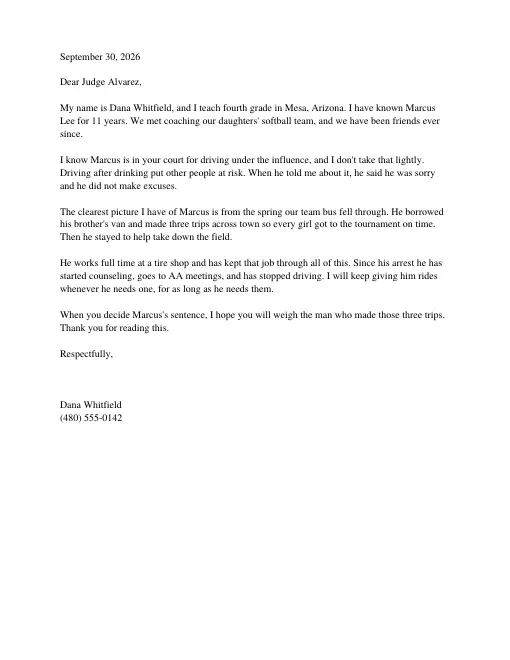
Get your letter print-ready
Word + PDF · your details filled in · 3 tone rewrites · sending instructions
This letter + up to 4 more from family and friends · no two alike
See a sample print-ready letter (PDF) · Word
Family pack: you pay once → you get a private link → each relative or friend answers their own questions and gets their own letter → everyone downloads from their own page.
Questions people ask
Can I use ChatGPT to write a character letter for court?
Yes, many people do. It works best as an editor for your own notes, not as the author. Give it only true, first-hand facts, tell it not to invent anything, and check every sentence before you sign. Your loved one’s attorney should review the letter before it is filed.
Is it OK to use Claude or Gemini instead of ChatGPT?
Yes. The same prompt and the same checks work with any general AI assistant. The risks are the same too: all of them can add details you never gave them.
Will the judge know the letter was written with AI?
Judges notice letters that sound generic or that share wording with other letters in the same case. They are much less likely to discount a letter that is short, specific and clearly in the writer’s own voice — however it was drafted. Read it aloud; if it doesn’t sound like you, rewrite it.
What is the biggest risk of using AI for a character letter?
Invented details. General AI assistants tend to fill gaps with plausible-sounding stories, feelings or promises. In a court letter, a single detail that isn’t true can undermine the whole letter — and the writer is the one who signs it.
Should I put real names and case details into ChatGPT?
Use placeholders instead of full names, addresses, dates of birth and case numbers while drafting, and never paste confidential messages from the attorney. Add the real names at the end, in your own document.
What’s the difference between ChatGPT and CharacterLetter.com?
ChatGPT is a general assistant: you write the prompt and you do the checking. CharacterLetter asks court-specific questions, drafts one page in your voice, and automatically checks every sentence against what you actually told it and against published federal defender guidance before you see it. Reading and copying the full letter is free; a print-ready Word/PDF version is $12.99 one-time.
Last reviewed 2026-09-30. This page is general information, not legal advice. It follows published guidance from federal defender offices and federal courts, including:
- Writing a Character Letter — Federal Public Defender, District of Maryland
- Letter of Support — Federal Public Defender, District of Vermont
- Character Letters in Support of Sentencing — U.S. District Court, District of Arizona
How we use these sources and test our letters: about CharacterLetter.com.