
Character letter for a DUI: sample letter to the judge
DUI letters have their own rules: acknowledge that other people were put at risk, and focus on what has changed since — treatment, sobriety, and how the person gets around now.
Write yours nowFree character letter for court tool · about 5 minutes · no sign-up
We’ll start from this exact situation — about 3 minutes.
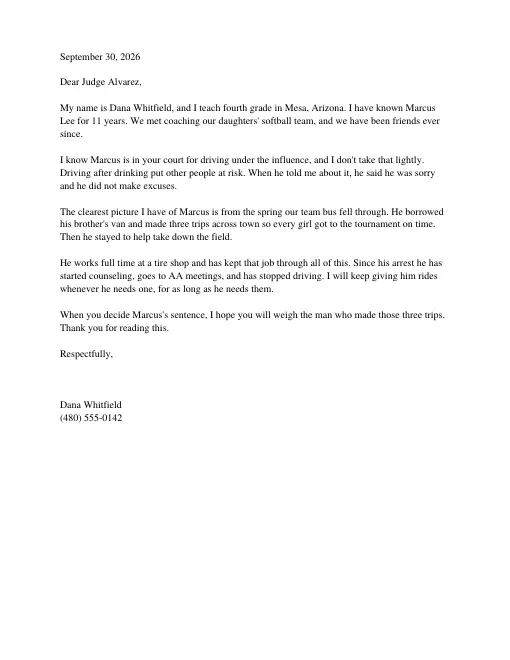
The sample letter
All names and details below are fictional.
Dear Judge Carter,
My name is Rebecca Stone. I am an elementary school librarian in Boise, Idaho, and I have known Nathan Price for nine years through our church, where we both help run the Wednesday youth program.
I understand that driving after drinking put other people on the road at risk, and so does Nathan. He has never once suggested to me that it was not a big deal. He has said the opposite, and I believe he means it.
For as long as I have known him, Nathan has been the adult the teenagers in our program trust. When one of our students lost her mother two years ago, Nathan and his wife made sure she had a ride to every practice and a place to go on the evenings she did not want to be alone.
Since his arrest Nathan completed an alcohol assessment and the classes that were recommended, attends AA meetings every week, and has not had a drink. He has stopped driving altogether and rides with me or his wife to every church event and to work.
I respectfully ask the Court to consider the person Nathan is and the steps he has already taken. Thank you for your time and attention.
Respectfully,
Rebecca Stone
(208) 555-0133
Why this letter works
- The risk is named. The second paragraph acknowledges danger to others — the single most important line in a DUI letter.
- No arguing about the stop or the test. The letter never mentions blood-alcohol levels, the traffic stop, or “only a couple of drinks.”
- Sobriety steps, specifically. Assessment, classes, weekly meetings and not drinking are concrete and checkable.
- Transportation. Showing how the person gets around without driving answers a question the judge is already asking.
Tips for your own letter
- Never question the breath or blood test, the officer, or the stop.
- Don’t write “it was just a mistake” or “nobody got hurt” — it reads as minimizing.
- Mention treatment, meetings, or classes only if they are actually happening.
- If the person has stopped driving or uses an ignition interlock, say so.
What never to put in the letter
- That the person is innocent, or anything about the evidence.
- Blame for the victim, the police, or anyone else.
- A request for a specific sentence, unless the attorney asks for it.
- Private details: addresses, dates of birth, account numbers, children’s names.
More sample letters
Write yours in about 3 minutes
We start from this page’s situation — just check a few boxes and add one true story.
Let's start with you.
There are no wrong answers, and you can change anything later.
Tell us about them.
Only what you know to be true — a judge can tell the difference.
About you — for the opening line and signature (optional, you can add it later)
The moment you'd want the judge to see.
One true memory does more than any list of good qualities. Small, everyday moments are often the most powerful.
Here is the beginning of your letter.
What we did for you
Get your letter print-ready
Word + PDF · your details filled in · 3 tone rewrites · sending instructions
This letter + up to 4 more from family and friends · no two alike
See a sample print-ready letter (PDF) · Word
Family pack: you pay once → you get a private link → each relative or friend answers their own questions and gets their own letter → everyone downloads from their own page.
Questions people ask
Is a character letter useful for a first-offense DUI?
It can be, especially when it shows what the person has already done since the arrest. Ask the attorney whether letters are being submitted.
Should the letter mention the blood alcohol level?
No. Leave the facts of the case to the attorney.
Last reviewed 2026-09-28. This page is general information, not legal advice. It follows published guidance from federal defender offices and federal courts, including:
- Writing a Character Letter — Federal Public Defender, District of Maryland
- Letter of Support — Federal Public Defender, District of Vermont
- Character Letters in Support of Sentencing — U.S. District Court, District of Arizona
How we use these sources and test our letters: about CharacterLetter.com.